Envirocatalysts Blog
Tags
- AAP
- AQI Dashboard
- AQI Forecasts
- AQI Monitoring Stations
- Air Monitoring Stations
- Air Pollution
- Air Purifiers
- Air Quality
- Air Quality Index
- Air Quality Monitoring Stations
- Anand Vihar
- Anti-Pollution Plan 2026
- Artificial Rain
- Auto Industry
- BJP
- BKC
- BMC
- Bhupender Yadav
- Bihar
- Biogas
- Byrnihat
- CAAQMS
- CAQM
- CPCB
- Cancer
- Carbon Monoxide
- Chandni Chowk
- Chennai
- China
- Clean Air
- Climate Change
- Cloud Seeding
- Coal Mining
- Coal Plants
- Construction
- Construction Sites
- DPCC
- DSS
- December 2025 AQI
- Delhi
- Delhi AQI
- Delhi Air Pollution
- Delhi Air Pollution Monitoring Stations
- Delhi Air Quality
- Delhi EV Policy
- Delhi EV Registration
- Delhi Government
- Delhi Heat
- Delhi NCR
- Delhi Pollution Monitoring Stations
News Outlet
- 102.7 Super Hits
- 104.1 Wiky
- 20 Minutes
- 96.3 Jack FM
- ABP
- ABP Live
- ANI
- Aeroagora
- Agência Brasil
- All India News Network
- Amar Ujala
- Amrit Vichar
- Arab News
- Asia News Network
- Asianet News
- Automobil India
- Awaz The Voice
- Bao Tin Tuc
- Big News Network
- Bio Energy Times
- Bloomberg
- Bombay Samachar
- Bombay Samachar English
- Bulletin of The Atomic Scientists
- Business Standard
- C News Live
- CNBC TV18
- CNN
- Career Ahead
- Courrier International
- Crack Academy
- CredyFi
- Custommapposter
- DNP India
- DailyExcelsior.Com
- Dainik Bhaskar
- Dainik Jagran
- Deccan Chronicle
- Deccan Herald
- Delhi Pollution
- Desi Metros
- Desi Talk Chicago
- Deutsche Welle
- Devdiscourse
- Dhaka Tribune
- Down to Earth
- Drilled Media
- ET Auto
- ET Health World
- ET Infra

Sharp PM2.5 surge after 10pm on Diwali in Gurgaon, Sector 51 tops
On Diwali night, the city's PM2.5 level soared to 16 times the national safe limit, exposing lakhs of residents to hazardous air as crackers burst well beyond the Supreme Court's 8-10pm window.

As pollution peaks across Delhi, many stns go blank
Several air quality monitoring stations in Delhi, including RK Puram, went offline for hours on Diwali night, leaving critical PM2.5 data missing during peak pollution hours. Experts said the data gaps skewed average readings and hindered analysis of pollution sources. Sunil Dahiya, founder of EnviroCatalysts, said missing data hampers understanding of pollution trends and called for improved data transparency and monitoring practices.

Pollution up 8x, firecrackers account for 40% of it
Firecracker emissions contributed between 30% and 40% to Delhi’s pollution on Diwali, with PM2.5 levels spiking eightfold due to stagnant wind conditions. Experts said calm weather and poor dispersion worsened air quality overnight, pushing pollution levels 60–67 times above WHO’s safe limit. Data analysis by EnviroCatalysts revealed that PM2.5 levels on Diwali night have consistently surged 200–300% compared to pre-Diwali levels since 2021.

Sharp PM2.5 surge after 10pm on Diwali, Sec 51 tops
On Diwali night, Gurgaon’s PM2.5 levels soared to 16 times the national limit as residents continued bursting crackers well past the Supreme Court’s permitted 8–10 pm window. The hourly concentration of PM2.5—a fine particulate pollutant linked to respiratory problems—rose sharply, with Sector 51 recording the highest at 949 micrograms per cubic metre around midnight. Despite restrictions, fireworks continued sporadically till 2 am in several neighbourhoods, including DLF phases, Sector 56, Palam Vihar, and Golf Course Extension. Residents complained that noise and smoke lingered for hours, reducing visibility. Officials said the city’s air quality remained in the ‘severe’ category for several days after Diwali.

Haze after lights: Unlike last year, AQI set to plunge post-Diwali day
Gurgaon is expected to witness dense haze following Diwali as weather conditions turn unfavourable for pollutant dispersion. According to the IMD, wind speeds will drop below 8 kmph, and calm conditions may trap smoke, causing AQI levels to deteriorate sharply after the festival.
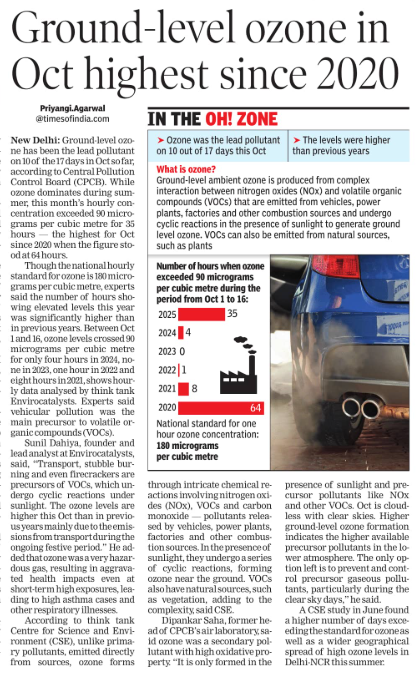
Ground-level ozone in Oct highest since 2020
Ground-level ozone has been the lead pollutant on 10 of the 17 days this October, according to the Central Pollution Control Board (CPCB). While October normally sees the highest ozone levels, this year’s concentration exceeded 90 micrograms per cubic metre on several days, making it the highest for October since 2020.

30% less-polluting means little for air quality when cracker volume goes up, say scientists
Scientists warn that even if green crackers reduce pollution by 30 %, the very large number of fireworks burst during Diwali in Delhi-NCR could cancel out that gain.
They argue the scale of use, weak enforcement, and mixing with conventional crackers limit any real benefit to air quality.

Ahead of Supreme Court order, Delhi split on green crackers
Ahead of a Supreme Court decision, people in Delhi are split on "green crackers". Some residents support the eco-friendly fireworks for Diwali, while others are against any firecrackers because of the city's poor air quality.

Breathing fire: Green crackers are less toxic, but will still choke you
While "green crackers" are less toxic than regular fireworks, experts warn they will still pollute Delhi's air. Using them will add to the city's severe pollution and make it harder to breathe, especially during winter.

रंग बिरंगी आतिशबाजी से गूंजेगा आसमान! दिवाली पर 'ग्रीन पटाखे' की हो सकती है धमाकेदार वापसी, पढ़िए बड़ा अपडेट
"Green crackers" are set to return for Diwali in Delhi, but their sale is waiting for a final decision from the Supreme Court. These special fireworks are known for causing about 30% less pollution compared to traditional ones.

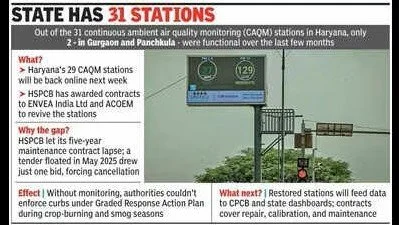
Gurgaon begins recording AQI data after months: All 4 stations go live, many monitors in Haryana still in dark
After being offline for several months, all four air-quality monitoring stations in Gurgaon have now started recording data again and are connected to both state and central pollution dashboards.
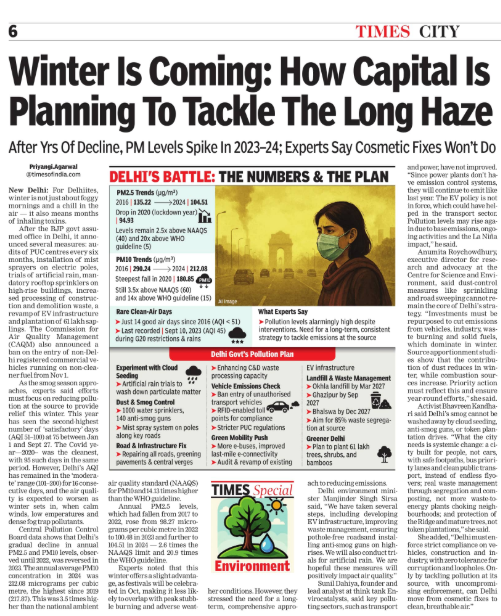
Winter is coming: How capital is planning to tackle the long haze and worsening air quality
Delhi’s air quality has worsened significantly in 2023-24, with PM2.5 and PM10 levels rising despite various government measures like PUC audits, mist sprayers and EV infrastructure. Experts stress that superficial fixes are inadequate, urging a comprehensive approach to reduce pollution at its source from transport, power and waste, advocating for systemic change and strict enforcement for breathable air.



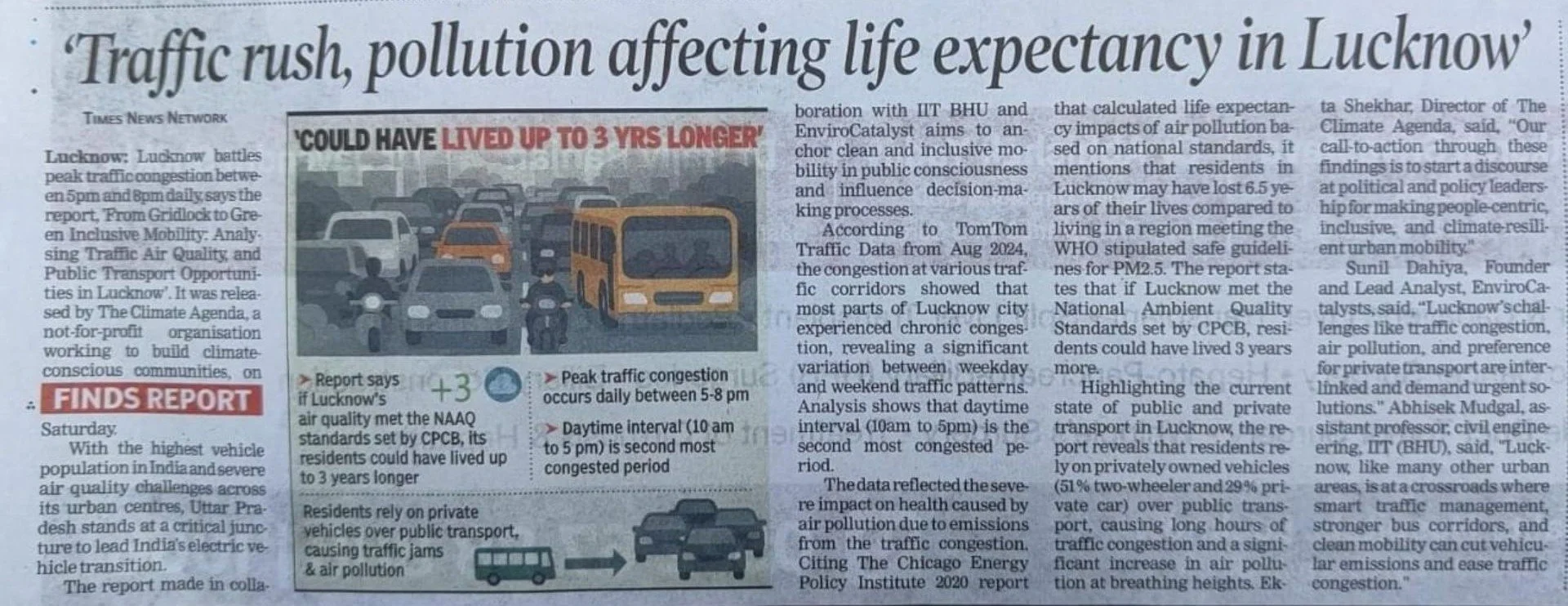
Traffic rush, pollution affecting life expectancy in Lucknow
The report highlights that traffic congestion and air pollution in Lucknow are reducing life expectancy, with private vehicle use and weak public transport being major reasons.